Wine

Off to Spain. Again.

Readers who've been following us for a while know that we have a special love for Spain and its varied cuisines. In fact, if you just plug “spain” into the search box to the right, you'll find multiple pages of posts about Spain and Spanish food stretching back to November 2009, when we wrote about the fabulous blue cheese of the Picos de Europa, Cabrales, and gave you a recipe for Cabrales with sauteed apples, walnuts, and honey. Peruse those pages and you'll find recipes for authentic paella, patatas riojanas, and a number of other Spanish classics. There are also some Spanish-inspired originals, like saffron shortbreads and orange and almond tart. We're heading back to Spain this week for some extended research, with stays in...Read More

First Vineyard marks origin of American winemaking

The first libations that come to mind in north-central Kentucky are likely to be bourbon, and, if you're a craft brew fan, beer. But the first commercial winery licensed in the Midwest and adjacent South was actually in Jessamine County, Kentucky in 1799. (Franciscans, of course, were making wine in the missions along the Rio Grande and in California a century and a half earlier.) The current owner of the land, Tom Beall, has rescued that tidbit of history by resuming production at First Vineyard (5800 Sugar Creek Pike, Nicholasville, Kentucky; 859-885-9359; www.firstvineyard.net). John James Dufour hailed from a wine-making family in the French-speaking part of Switzerland. In the 1790s, he purchased a piece on land on the Great Bend in the Kentucky River that...Read More

Franciacorta: effervescent joy from Italy

Contrary to common usage, there's nothing like real Champagne, the sparkling wine made in a delimited area in France. We'd suggest that there is also nothing like Franciacorta, the elegant and more affordable sparkling wine made in the Lombardy countryside an hour east of Milan. In fact, that city's fashionistas have been drinking a lot of Franciacorta for the last several days during Milan Fashion Week. The district has been growing grapes at least since the 16th century under the aegis of the region's monasteries. (The name of the region indicates a region of monasteries not subject to ducal taxes.) Serious spumante production is much more recent, dating from the years after World War II, and the big players are industrialists, not monks. That said,...Read More

Craggy Range shows original NZ wines

Matt Stafford (above) isn't just any winemaker. He's a winemaker who came to the trade originally as a soil scientist. The post-grad diploma in viticulture and oenology came later, but the grounding (no pun intended) in soil might just make him the ideal person to make wine for Craggy Range (www.craggyrange.com) in New Zealand. Stafford was in Boston a few weeks ago to introduce some of his wines. New Zealand has become notorious for popular sauvignon blanc and pinot noir--even though the former often tastes medicinal and the latter like cherry cough syrup. It was a pleasure to taste elegant New Zealand wines that spoke first and foremost of terroir. It was clear that Stafford wanted to confound expectation when a few of us gathered...Read More

Mullan Road shows the grandeur of Walla Walla red

Given that his family name is practically synonymous with Napa, it was a pretty good bet that when Dennis Cakebread started making wine near Walla Walla, Washington, he was going to call it something else. So he named his new winemaking venture for the historic wagon road across the Rockies from present-day Montana to present-day Walla Walla that was surveyed in 1854 and built 1859-60. We suspect that what appealed to Cakebread was that Lt. John Mullan was a pathfinder and a visionary. More than 150 years later, portions of I-15 and I-90 follow the same path that Mullan took over the Rockies. Cakebread is looking to pioneer a Washington red worth laying down in your cellar. His first Mullan Road Cellars red (2012) was...Read More
Bordeaux is just the beginning for Lafite

Bordeaux is just the beginning for Lafite

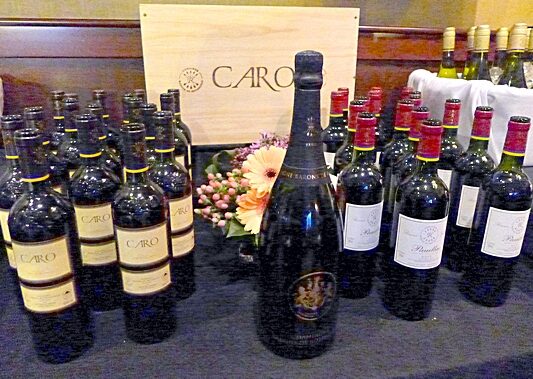
Château Lafite Rothschild is legendary for its red Bordeaux, many of them too expensive for all but special occasion meals. Fortunately, the parent company, Domaine Barons de Rothschild (Lafite) (www.lafite.com), has been spreading Lafite's winemaking skills around the globe to create more affordable wines. And back home in Bordeaux, they've developed a series of soft, ready-to-drink red and white wines under the Réserve Spéciale line. We had the chance to try several of the different branches of Lafite at a wine dinner at The Palm Boston, and we're happy to say that the Lafite junior lines show that good wine can be made at a good price. We started by drinking the Lafite Réserve Spéciale Blanc 2013. White Bordeaux, especially from the Entre-deux-Mers district, doesn't...Read More

Pantelleria vineyards honored by UNESCO

It's a delight to learn that the United Nations has honored the grape growers of Pantelleria, naming the island's viticultural technique part of the UNESCO Intangible Cultural Heritage of Humanity. And here I thought it was merely heroic. That's what the Pantellerians themselves call it. About halfway between Sicily and Tunisia, the rocky island of volcanic origins is arid and scoured by ferocious winter winds that stunt even the olive trees. Typically, houses are cut into the rock to provide protection from the wind and the blistering sun. The grapes are grown on “head trained bush vines” (vite ad alberello, in Italian). Each one is planted in a depression and trained in a low, broad bush system with two to four branches. Vines are typically...Read More

TWL: Prosecco lifestyle at Villa Sandi

Villa Sandi (Via Erizzo 112, Crocetta del Montello; +39-0423-665-033; www.villasandi.it) is one of the most striking producers of both Prosecco DOC and Prosecco DOCG wines. The winery's headquarters and cellars sit amid formal gardens in a verdant landscape. The property resembles a fairytale version of how a distinguished Italian winery should look. Nestled into the hills of the Marca Trevigiana about 25 kilometers northwest of Treviso, the estate borders the Piave river. The cellars once had a passageway that led to the riverbank, which Italian soldiers used to move surreptitiously during World War I. The villa itself, pictured above, is a splendid example of Palladian architecture built in 1622. It is a real period piece, with several rooms maintained in high 17th-century style, complete with...Read More

TWL: Prosecco over the line in Friuli

The most rarefied Prosecco may come from the hills between Conegliano and Valdobbiadene, as suggested in an earlier post but some superb examples also come from the plains and river valleys eastward toward Pordenone in Friuli. It may be an entirely different political region from the Veneto, yet it's less than 40 km (25 miles) from Conegliano. Driving east on the A28, it's even worth taking a 15-minute detour to the village of Francenigo to see the historic power-hammer smithy — the Maglio di Francenigo — that's one of the last touchstones of the agricultural heritage. The Pessot family started making tools to till the fields and vineyards, using water power from a falls on the Livenza River to raise and lower the power hammer...Read More

TWL: Visiting the school for Prosecco

[caption id="attachment_2618" align="alignleft" width="510"] Vineyard of Glera clones at Oenology School.[/caption] According to the Prosecco DOC consortium, farmers in the Friuli Venezia-Giulia village of Prosecco began making sparkling wine from the grape now known as Glera around 1600, and it became so popular that it spread to nine provinces in the 17th century. (Those provinces now lie within Friuli and the Veneto, and the symbol of Prosecco DOC is nine wine glasses.) Originally a farmhouse wine, Prosecco would stop fermenting in the fall when the weather cooled, then begin again in the spring, when it was sold as a “frizzante” wine. Antonio Carpenain invented modern Prosecco in the mid-19th century when he began using a pressurized tank for a second fermentation. His adaptation of France's...Read More