Wine

Ocean meets wine country in Pismo Beach

California beach country is often also wine country. On the Central Coast, wineries nestle in the foothills of the Santa Lucia mountain range only about five miles from the ocean. The San Luis Obispo wine country comprises about thirty wineries squeezed into the hills between Arroyo Grande in the south and San Luis Obispo in the north. Over the hills in Pismo Beach, Lissa Hallberg of the Tastes of the Valleys wine tasting bar and bottle shop was eager to introduce me to their products. The coastal village just over the mountains from Arroyo Grande boasts a long strand of soft sand. The town resists modernization, preferring to embody the classic, low-key beach getaway. In the morning, fishermen cast for Spanish mackerel off the 1,200-foot...Read More

Endrizzi ecological stewardship inspires great wine

Vineyards can be some of the most beautiful places on the planet, but few have charms to rival the original family vineyards of Endrizzi. Located in San Michele all'Adige (locale Masetto; tel. +39 0461 650 129: www/endrizzi.it), the winery launched in 1885. Masetto is also the name of the name of the family homestead. In those days, the area was part of the Austro-Hungarian empire. Endrizzi operated wine shops in Vienna, Prague, Belgrade, and Switzerland. After World War I, Trentino reverted to Italian control. The wine, however, has always been bilingual. Trilingual, if you count the origin of some of the grapes. Founders Francesco and Angelo Endrici (the Italian spelling of the family name) pioneered Trentino plantings of cabernet sauvignon and merlot. Those French grapes...Read More

Mezzacorona proves big wineries can make fine wines

Not all Trentino wine producers are modest family affairs. Established in 1904, the Mezzacorona cooperative (www.mezzacorona.it/en-us) comprises 1,600 members. Their vineyards stretch across 3,000 hectares (about 11.6 square miles). They grow a third of the grapes in Trento province—about 30,000 tons per year. And they make surprisingly good wine. Three-quarters of the grapes grown by Mezzacorona members are white. The most important are pinot grigio and chardonnay. Mezzacorona pinot grigio is certainly well-known in the U.S. and Germany, where it is a nationwide top seller in both countries. Wine Enthusiast magazine gave the 2014 a score of 87 and rated it a “best buy.” Annual production reaches about 50 million bottles. In the U.S., it sells for as little as $8 at a discount wine...Read More

Warm wind makes fine Letrari wines in Vallagarina

Every afternoon at 3 p.m., warm air sweeps north from Lake Garda into the Vallagarina, the low hills around Trentino's southern portion of the Adige River. Vineyard owners call it “L'Ora,” or “the hour,” and swear that you could set a clock by it. All through the summer, this steady breeze provides warmth and aeration to the grapes. It drives up the sugar concentration and sweeps away potential fungal infections. The warm, dry wind makes the Vallagarina one of the best places in Italy to grow heat-loving grape varieties. The big reds from Bordeaux flourish here. So do the classic grapes of sparkling wine: chardonnay and pinot noir. The Letrari family has been making wine in Italy's Trentino region for the last few centuries. The...Read More

Grigoletti makes superb wines a family affair

Slender and willowy, Bruno Grigoletti reaches his big hands into the canopy of a grape pergola and starts ripping out the extra foliage. In his late 70s, he works at a pace that would exhaust a man a third his age. Bruno manages a dozen family vineyards. They total about 15 acres (6 ha) in and around the commune of Nomi on the west bank of the Adige river, 9 miles (15 km) south of Trento. Some of the heat-loving varieties grow at the edge of the village in the alluvial soils of the Adige. But the most striking wines come from steep vineyard plots on the limestone hills behind the village. Bruno prunes the white grapes—mostly pinot grigio, chardonnay, and sauvignon blanc—three times across...Read More

Hearty Trentino dishes complement the wines

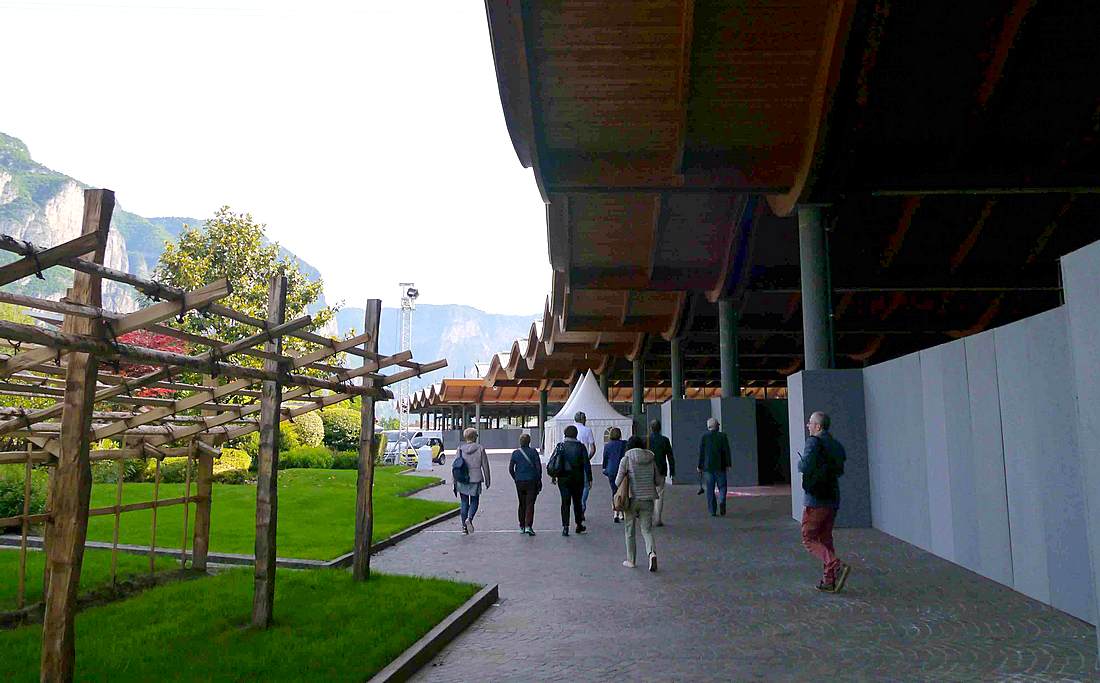
If you're going to spend all morning tasting 128 wines, you really need some hearty food to follow up. The Trento cuisine is a fascinating blend of Italian and Germanic foodways, and it's well suited to the regional wines. After we sampled our way through the wines, most of us had absorbed enough alcohol, even without swallowing, that we really needed a good meal. The Trentino wine consortium made sure we got it! We started with a glass of light white wine made from the Incrocio Manzoni Bianco grape. It's part of a group named for professor Luigi Manzoni (1888-1968), who experimented with crossing a number of grapes during the 1920s and 1930s at Italy's oldest school of oenology in Conegliano, north of Venice. The...Read More

Trentino shows off its superb wines at Mostra Vini

The wine district of Trentino is one of Italy's best-kept secrets—at least from Americans. That translates into real bargains on some outstanding wines from unfamiliar producers. Trentino is the southern half of the region of Trentino-Alto Adige east of Lombardy and west of the Veneto. To help you place it, the wine district more or less corresponds to the Trento province in the map below. With high-altitude vineyards on a mix of dolomitic limestone and volcanic porphyry, the area produces startlingly good sparkling wines in the style of Champagne, highly aromatic white wines similar to the style of Alsace, and some fascinating local reds that many Americans have never heard of. Napoleon rolled through in the early 19th century, and many chardonnay, merlot, cabernet, and...Read More

Frescobaldi celebrates its Tuscan estates

There's poetry in the Frescobaldi soul, and I don't just write that because I like so many of the family's wines. Back in the 13th century, poet Dino Frescobaldi helped his exiled friend Dante Alighieri recover the first seven books of the Divine Comedy, enabling him to complete one of the great masterpieces of world literature. About that same time, the Frescobaldi family also started to focus on making wine in the Tuscan countryside. A couple of years ago, Lamberto Frescobaldi took over the leadership of the family business, and since he has a son at college in Rhode Island, the chief often passes through Boston. When he was here in March, we had a chance to sit down and taste some current releases and...Read More

And the winning Champagne is…

What was our best bubbly of 2015? We've been fortunate this year to enjoy some spectacular sparkling wines, from a range of proseccos to an elegant pink Franciacorta to several cavas and crémants that we simply drank without taking notes or photographs. (Even wine and food writers are entitled to a day off.) But the champagnes of Barons de Rothschild (www.champagne-bdr.com) really took us through the seasons. We started off in warm weather with the non-vintage brut, which is the company's anchor champagne. It's blended with 60 percent chardonnay (mainly grand crus in the Côte des Blancs) and 40 percent pinot noir (principally from the villages of Verzenay, Ay, Mareuil-sur-Ay, and Bouzy). It has a Rumpelstiltskin straw-gold color, a faintly yeasty aroma, and fine and...Read More

Sherry takes back the bar

When we were in Madrid in October, we were happy to see that the Tío Pepe neon symbol darkened by the corporate forces at Apple had switched sides of Puerta del Sol and was lighting up the plaza again from atop El Corte Inglés department store. (See above.) The bright lights seem symbolic of the broader rehabilitation of the image of sherry. For a long time, drinking sherry implied that you were were old, prissy, British or all three. But now that cream sherries (a hideous adulteration of sherry by blending with sweet wine) are all but a thing of the past, cocktail-savvy drinkers are embracing real sherry in all its complex, nuanced forms. And though we're a little late to the party, we want...Read More