For us, the best cookbooks function as travel guides. They introduce us not just to a group of recipes but to a culture, a way of life, and a way of sharing. Cooking might be the ultimate love language. It sends the message ‶I cook for you because I care for you.″ Or it might simply say, ‶Welcome into my home.″ Either way, the sharing of a recipes is, like the sharing of food, a venerable form of offered intimacy. A House in the Lebanese Mountains by Sarah Trad (Thames & Hudson, New York, 2026; $45) is a beautiful extended meditation on the meaning of home and hospitality. The house in question is Beit Trad (beittrad.com), a guesthouse set in the mountains above Beirut, Lebanon, overlooking the Mediterranean. In a part of the world better known for war and strife, Beit Trad is a peaceful sanctuary high above the city.
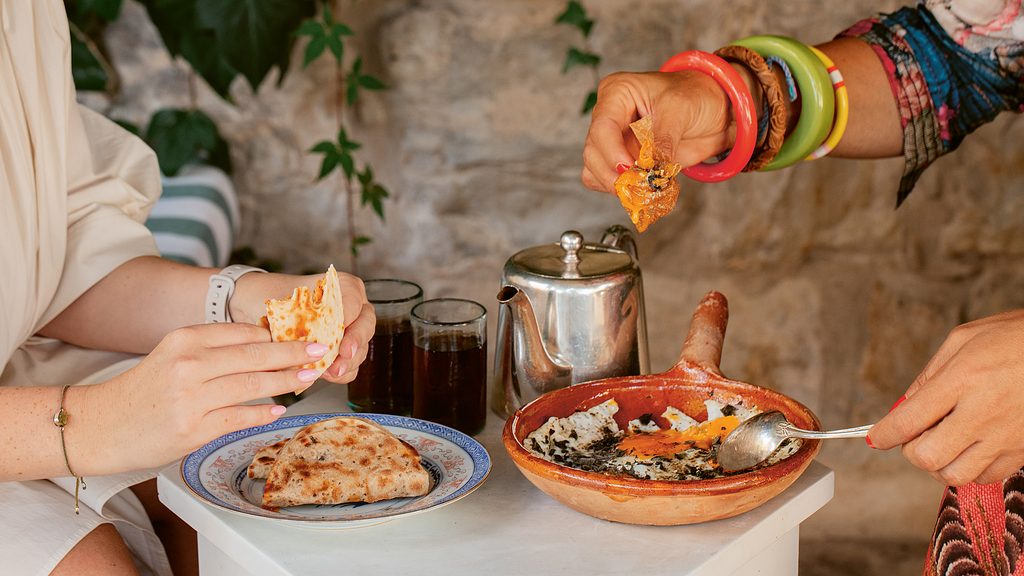
Stunning photography by Matthieu Salvaing (reproduced here by permission) evokes a pampered languor where guests might come to rest and ‶do absolutely nothing,″ as Trad puts it. The story of how the 18th century house evolved is Trad’s personal account of an emotional journey. The property was her family’s summer home anchor in Lebanon from 1985 on — during peace and war. Before her death, Trad’s mother made her promise to look out for the property. In 2013 she undertook the restoration, finally opening it as a guesthouse in 2018.
This account of the barebones of the narrative cannot do justice to the emotive storytelling of the book. In many ways, it is about honoring Levantine hospitality, about duty to family memory, and about recapturing Trad’s own Lebanese identity. The creation of Beit Trad was a homecoming, of sorts.
A big part of the book is the collection of traditional Lebanese recipes enjoyed by the family and guests at Beit Trad. In a way, this book landed on our doorstep at just the right season, when most flat spaces in our kitchen and dining room were overflowing with an abundant harvest of garden produce. It’s giving us new ideas for our tomatoes,eggplant, zucchini, and cucumbers. With permission from the publisher, Thames & Hudson, Inc, (thamesandhudsonusa.com), we are reprinting a pilaf recipe that gives a flavor of the book’s style.
BULGUR & TOMATO PILAF
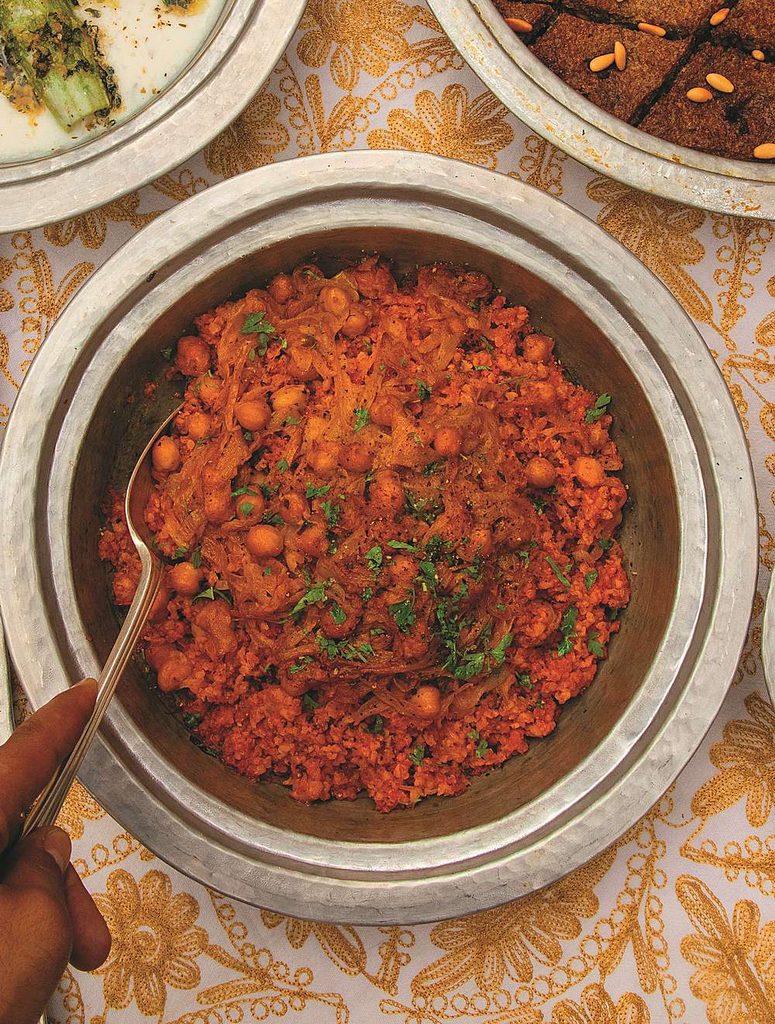
This was one of my mom’s favorite dishes. There are many variations on a bulgur and tomato pilaf, with some cooks adding vegetables such as chopped zucchini or eggplant; our version includes chickpeas sautéed with onions and spices. We like to serve ours with a fresh tomato, onion, and parsley salsa, while some prefer a dollop of thick yoghurt. We approve of both!
SERVES 4 AS A LIGHT MAIN OR SIDE
- 10 ½ oz coarse white bulgur
- 4 ½ oz cooked chickpeas
- 1 onion
- 1 lb 2 oz fresh or canned chopped tomatoes
- ¼ cup olive oil
- fine sea salt
- ½ teaspoon white pepper
- ¼ teaspoon ground turmeric
- ¼ teaspoon sweet paprika
- 3 tablespoons tomato paste
SALSA:
- 1 white onion
- 1 tomato
- ½ bunch flat-leaf parsley, about ½ oz
- juice of 2 lemons
- fine sea salt
TO SERVE:
salted thick Greek-style yoghurt (optional)
Place bulgur in a fine-meshed sieve and rinse under cold running water, swirling vigorously, until the water runs clear. Drain and set aside.
DO SOME PREP FOR THE PILAF
If using canned chickpeas, drain and rinse them thoroughly.
Thinly slice 1 onion.
If using fresh tomatoes, cut them into quarters and pulse in a food processor until coarsely chopped.
TO COOK THE PILAF:
Heat 1/4 cup olive oil in a pot over medium heat. Add the sliced onion with a pinch of fine sea salt and sauté for 5-8 minutes, until soft and translucent.
Stir in the chickpeas, ½ teaspoon white pepper, ¼ teaspoon turmeric and ¼ teaspoon sweet paprika. Cook for another 2-3 minutes.
Remove half the chickpea mixture and set aside for garnishing the pilaf.
Stir in 3 tablespoons tomato paste and cook for 2-3 minutes. Add the bulgur, chopped tomatoes, and about 2 cups water, or as much as needed to cover the bulgur. Stir in 2 teaspoons fine sea salt.
Cover the pot, reduce the heat to low, and cook for 20 minutes.
TO MAKE THE SALSA:
When the pilaf is nearly ready, finely chop 1 onion, 1 tomato and ½ bunch of parsley. Toss in a bowl with the juice of 2 lemons. Season with fine sea salt to taste.
TO ASSEMBLE AND SERVE:
Uncover the pilaf pot and fluff the bulgur grains with a fork.
Transfer the warm pilaf to a serving dish and garnish with the reserved onion and chickpea mixture.
Serve the fresh salsa alongside, with some cold salted yoghurt if desired.