The generational turnaround in Sicily’s wine culture is almost enough to give a wine lover whiplash. Long known as a region of overcropped bulk wines that were shipped north for blending, Sicily has done a 180-degree turn. It’s become a region that takes pride in its indigenous grapes, a region where small, often experimental winemakers are pushing the limits with natural yeasts and extended skin contact. And while many larger operations have also embraced varietals best known in Bordeaux and the Rhône valley, the number of winemakers focusing on natural wines made from old-vine Sicilian grapes took us entirely by surprise.
The rise of an aspirational wine culture has also led to a spread of enotecas, or wine bars, where curious drinkers can taste a range of wines by the glass. Each enoteca will generally have up to a dozen wines open for sampling and drinking, with an emphasis on sampling. Having researched Sicilian wine bars before our trip, we planned to visit several around the island. Alas, many were closed due to weather or off-season hours. We did visit three in Palermo and one in Noto.
26 MQ Urban Winery
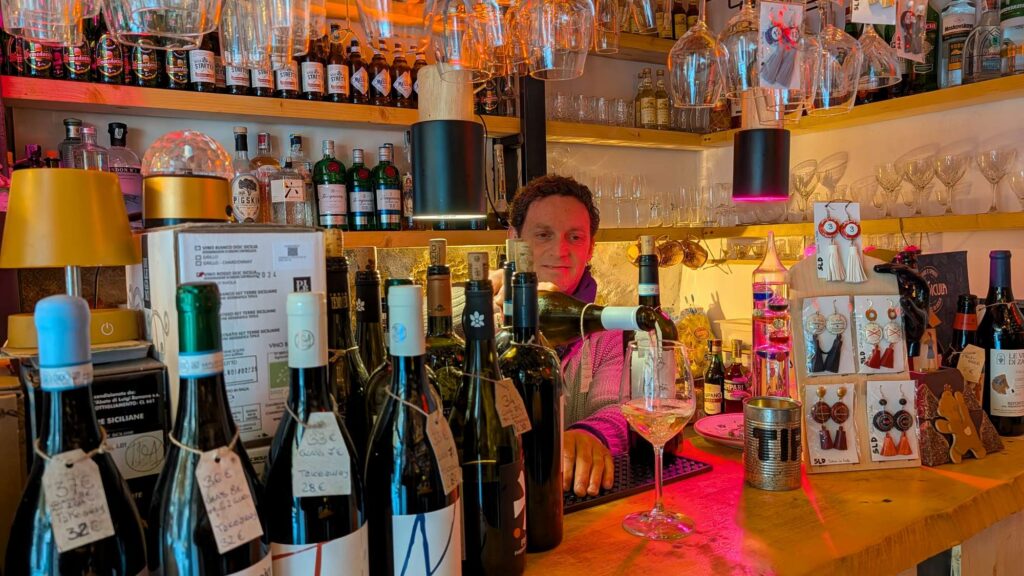
This unpretentious wine bar is just around the corner from La Matorana and Santa Caterina churches on Piazza Bellini. After the complex visual assault of those two UNESCO World Heritage buildings with their dizzying blend of Byzantine, Norman, and Baroque styles, a quiet sip of good wine was definitely in order. Owner Adriano Casamento asked us what we had been drinking (supermarket Grillo, we admitted sheepishly) and offered a couple of tastes of Grillo, Inzolia, and then a fascinating, very dry Etna white wine. A field blend of Carricante, Catarratto, and Minella from the foothills of Mount Etna, the wine was classified as Etna Bianco D.O.C. Light and bright, it had the characteristic Catarratto structure with just a hint of anise on the nose. Just right at the moment.
26 MQ Urban Winery, Via del Ponticello, 26, Palermo; +39 091 364943; instagram.com/26_winecellar
Bottega Monteleone
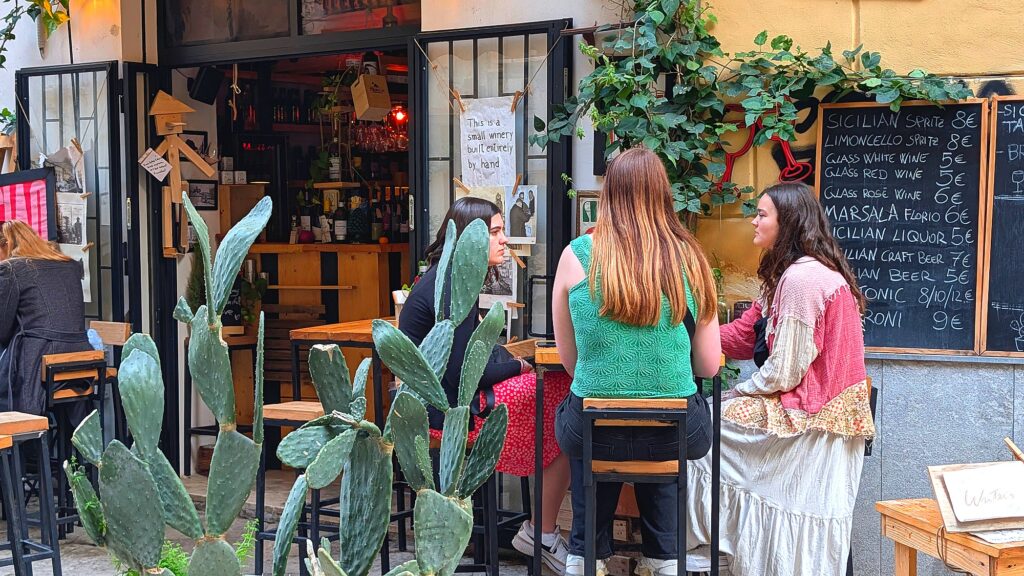
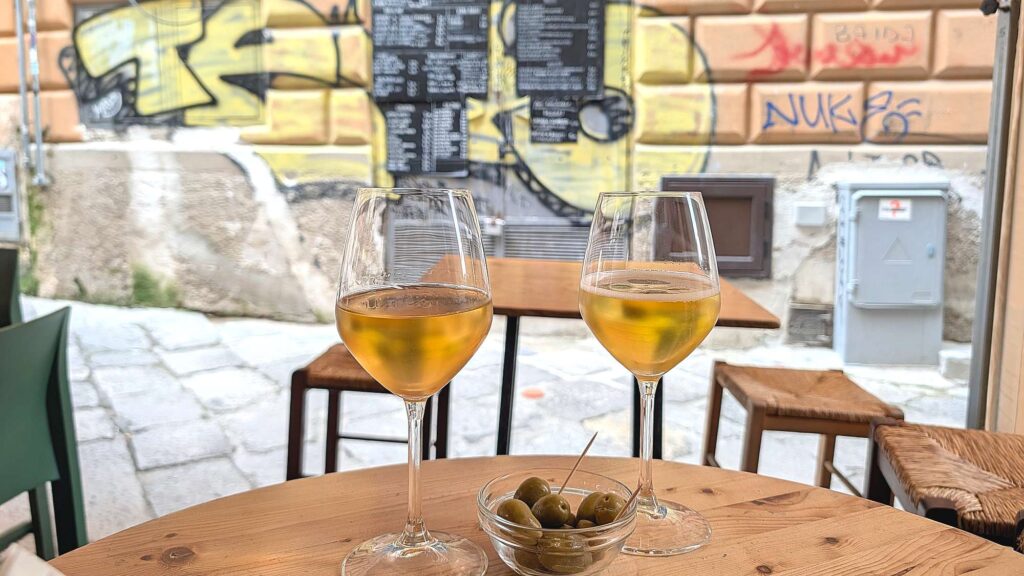
We’ve heard of garage wineries before, but Bottega Monteleone was the first garage enoteca we’ve ever visited. Literally occupying a former car garage in a narrow street off Via Roma near Piazza Due Palme, the wine shop sets out stools and barrels in the street to serve small antipasti plates and glasses of wine. We were intrigued because the extensive list of available wines included multiple expressions of the same grape. For example, Zibibbo — normally made into a sweet wine from partially dried grapes — was also offered as a natural wine, fermented using wild yeasts and minimal intervention. That version revealed the marvelous aromas of the Muscat grape with an almond and caramel finish. (Zibibbo is the Sicilian name for the grape more widely known as Muscat of Alexandria.)
In fact, most of the wines offered at Monteleone are natural wines, including many with extended skin contact. Such orange wines are all the rage in Sicily (as elesewhere), but we found them too oxidized when we tasted a few sips. On our server’s advice, Pat also tried a spumante brut made from Catarratto by the Coppola 1971 winery. Fresh and tingly, it was a great aperitif wine. We had been ignorant of sparkling Sicilian wines, but this example made us think we should do more exploring.
Bottega Monteleone, Via Monteleone, 10, Palermo; +39 091 746 6292; bottegamonteleone.com/en/
Dal Barone
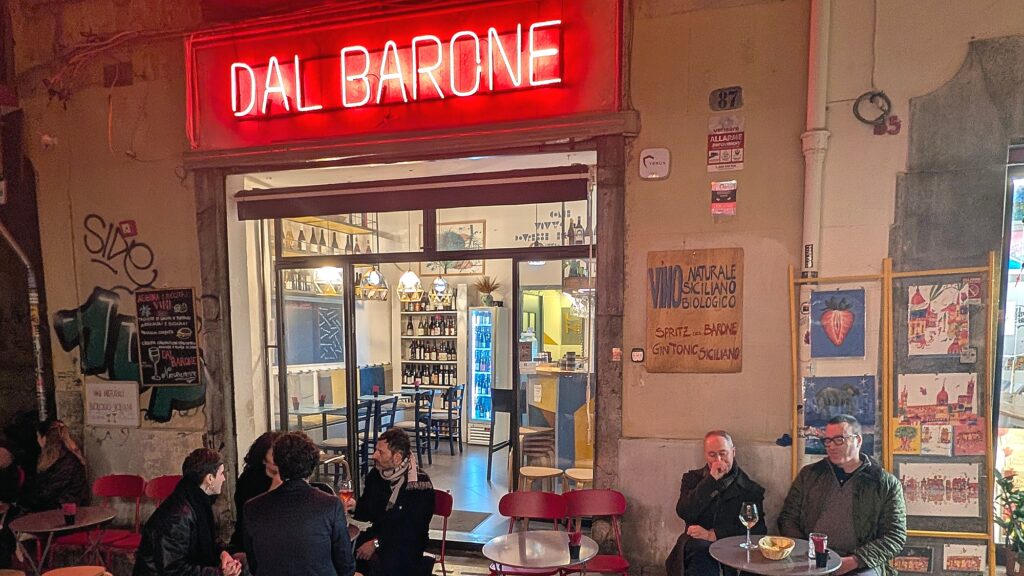
Natural wines are the mainstay of the 150+ bottles available at Dal Barone. This bold and brash wine bar doesn’t hide its light under a bushel, either. Bright red neon identifies the two rooms directly across the small street from each other. Both have tables on the sidewalk as well as some spots inside. Open six days a week from 6 p.m. to midnight, it’s clearly a mainstay of the neighborhood nightlife. (Hours on the door say it’s open at noon Thursday-Saturday, but that’s probably in-season.)
Fresh off a good experience with a frizzante, Pat wanted to explore further. We were offered two tastes — one a rosato with faintly oxidized overtones. the other pure Catarratto that was pleasantly prickly and extremely dry. Since there was only a single glass, David was offered a taste of Grecanico from Marsala. It was lightly salty but seemed awfully thin. Ultimately, he opted for a white blend from Barraco called Fior di Bianco. The roundness of Grillo was balanced by the mineral structure of Catarratto and enhanced with a bit of aromatic Zibibbo.
Dal Barone, Plazza San Francesco, 87, Palermo; +39 349 508 4347, dalbaronevino.it
RitroVino
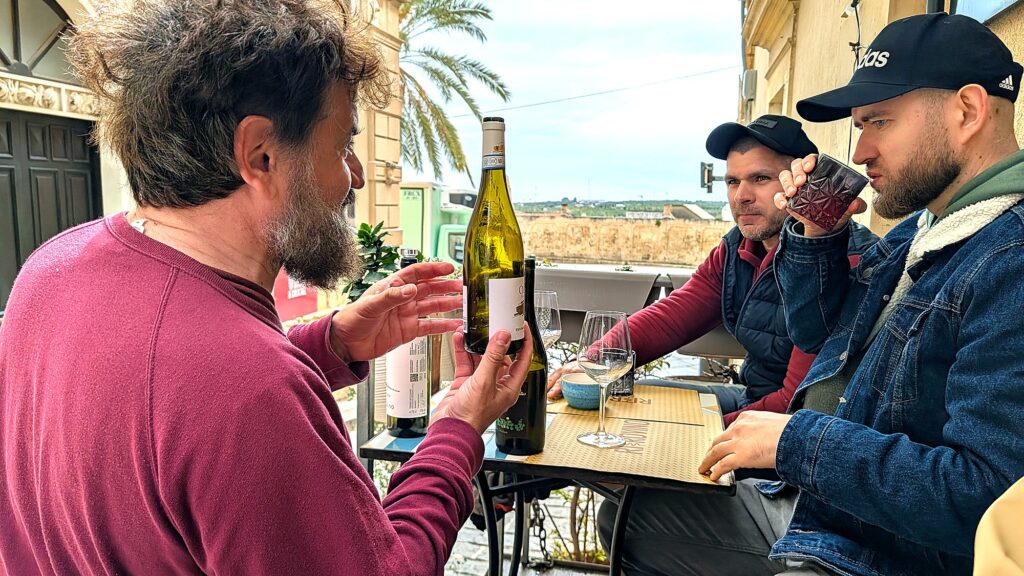
Our final wine bar was in Noto, a city known for Baroque architecture sprinkled with Liberty style buildings. We decided to have some panini for lunch at RitroVino. The wine bar was fun, blasting a soundtrack of American R&B. Just a small wine shop with a few tables on the sidewalk outside, RitroVino is all about wine. (That said, the panini with prosciutto, mozzarella, and sun-dried tomatoes were pretty good.)
We had learned from previous wine bar experiences that if we both said we were drinking white wine, we’d only get three wines to taste (at most). So David opted for red. Our server, Roberto Biagi, first brought three choices of white wine: a Grillo-Insolia blend, a Catarratto from the west end of the Val di Noto, and a sublime Alessandro Viola ‶Carricat″ from the slopes of Mount Etna. Pat chose the last. It was a natural orange wine made from organically grown Carricante and Catarratto grapes. Extended skin contact brought out more structure, but oxidation was controlled to avoid the sherry taint of many orange wines.
Red offerings were even more eclectic: a Syrah; a Bordeaux-style blend of Nero d’Avola, Cabernet Sauvignon, and Merlot; and a Cerasuolo di Vittoria DOCG. Both the Syrah and the blend were very well-made/ The blend was more interesting. Cabernet dominated, even though the Nero d’Avola had spent 8 months in new French oak. David opted for the Cerasuolo. The name suggests cherries, and it is a fruity red with cherry and bramble fruit on the nose. Blended from Nero d’Avola and Frappato, it seemed more quintessentially Sicilian. In the glass, the structure imparted by Nero d’Avola made a perfect frame for the fruit and spice of the Frappato.
RitroVino, Via Archimede, 4, Noto; +39 392 312 2757; ritrovinonoto.it