Tuscany has been so well marketed in the English-speaking world that the name immediately conjures images of rolling green hills (crumbling castle optional), vast verdant vineyards, and occasional forays into the sophisticated urban centers of Florence and Siena. To diners, Tuscany is roasted meats and bold red wines.
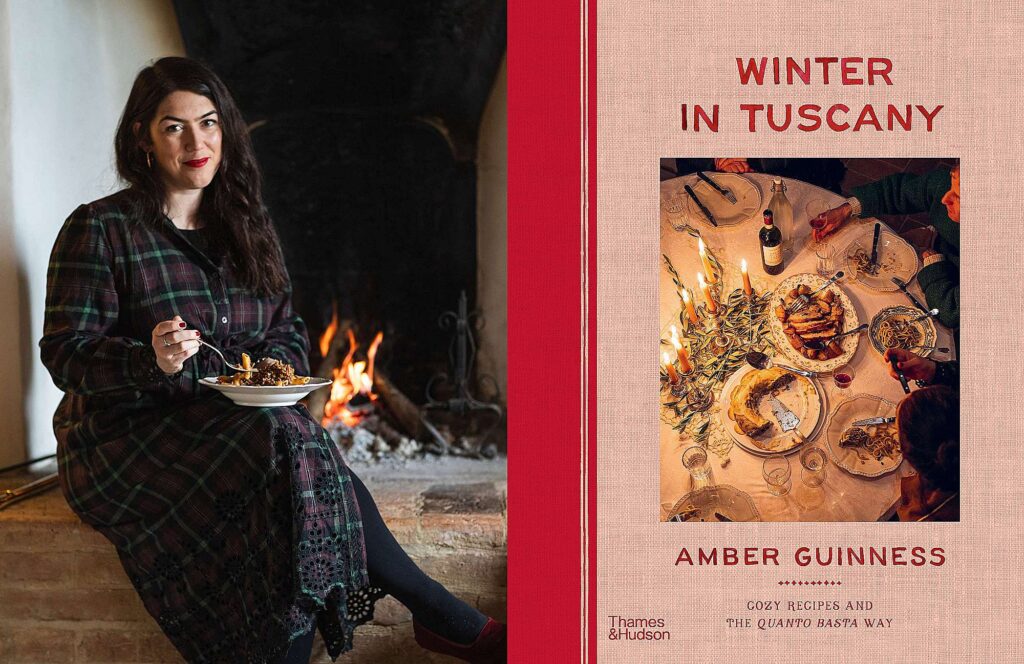
Born in London but raised in Arniano, Italy, cook and food writer Amber Guinness knows her way around Tuscany. Last spring we wrote about her book Italian Coastal, the follow-up to A House Party in Tuscany. We think that her just-published third book, Winter in Tuscany: Cozy Recipes and the Quanto Basta Way, expresses the spirit of the region even better.
The book is rooted in the quiet season when most of the tourists are gone and village and countryside life slowly percolate along in their own good time. Having produced two coffee table books highlighting Tuscany’s upscale side, Guinness comes back to the rustic home kitchens in Winter in Tuscany. Moreover, she emphasizes the Italian cooking concept of ‶quanto basta,″ which loosely translates to ‶as much as is needed″ or ‶just enough.″ Indeed, rather than exact measurements, Italian recipes are often written with the abbreviation q.b. next to an ingredient such as salt or extra-virgin olive oil. Guinness does provide those exact measurements in her recipes, but the spirit of quanto basta pervades the recipes. (The exceptions are the baked goods, where she acknowledges precise measurements make the chemistry work.)
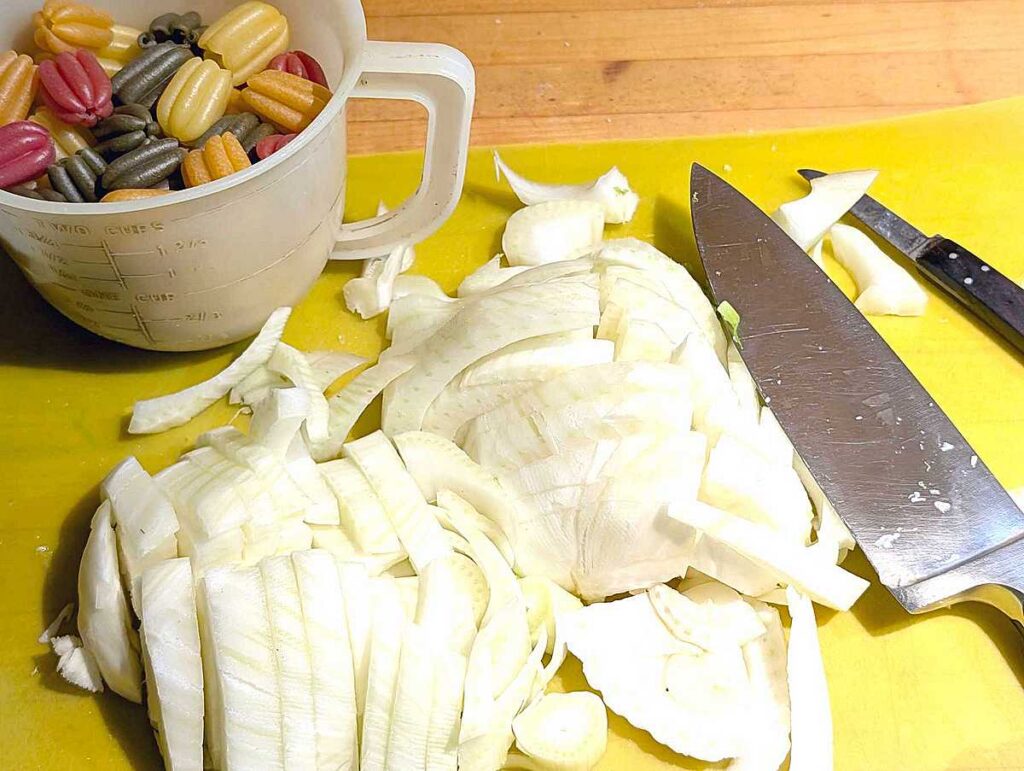
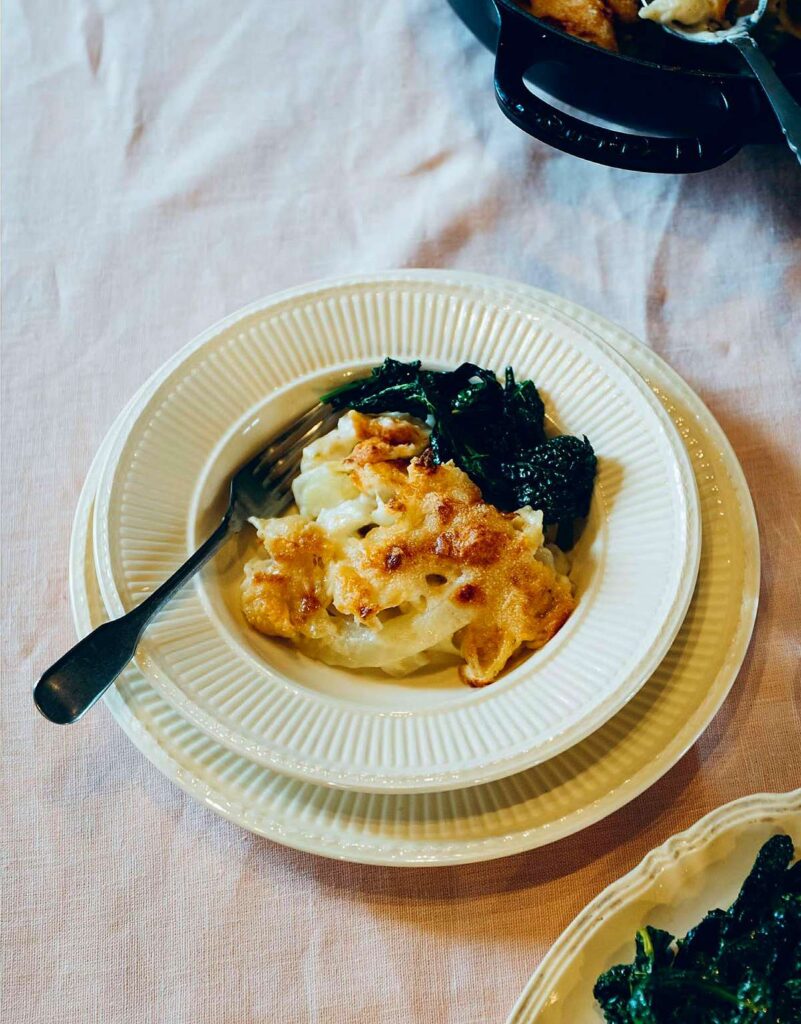
There’s an unforced warmth about this book that is very appealing for a winter’s read — and a winter’s recipe reference. The very first dish we made from it was ‶Baked fennel & pasta with bechamel.″ The photo at right shows how to cut the fennel so it cooks at the same time as the pasta. The dish is a refined Italian take on macaroni and cheese. We had some pumpkin-shaped tricolor pasta (‶harvest″ pasta, per the package label) just about the size of gnocchi. In our case, we baked the dish in individual gumbo bowls and topped each with finely chopped fennel fronds before serving. Not as pretty as the example in the book (see below), it certainly tasted great. We got permission to reprint the entire recipe as she wrote it so our readers can get a feel for Guinness’s warm style. Next we plan to test her chestnut and mushroom vegetarian take on a Tuscan pepper stew or peposa.
So, here’s Amber:
Finocchi, pasta e besciamella al forno
BAKED FENNEL & PASTA WITH BECHAMEL
At school in Buonconvento, for lunch we would often be given pasta al forno, parboiled pasta that was dressed either in bechamel or tomato sauce and baked in the oven with lots of parmesan on top. That was always a good day, as it’s exactly what you want to eat as a seven-year-old. It’s still one of my ultimate comfort foods, but nowadays I like to smuggle in some veg and a slightly more grown-up flavor by adding lots of fennel and some mustard.
PREPARATION: 15 minutes
COOKING: 45 minutes, plus resting time
SERVES 4
- butter, for greasing
- grated parmesan, for sprinkling
- 2 large fennel bulbs
- 10 ½ oz conchiglie, mezzi rigatoni, rigatoni or any short pasta
BECHAMEL
- 20 ½ fl oz full-fat milk
- sea salt and freshly ground black pepper
- 1 3/4 oz butter
- 1 3/4 oz all-purpose flour
- 1 1/2 oz grated parmesan
- ½ whole nutmeg, grated
- 1 teaspoon Dijon mustard
To make the bechamel, pour the milk into a saucepan with two pinches of salt and a few grinds of black pepper. Set over a high heat, and as soon as the edge starts bubbling, remove from the heat.
In a separate saucepan, melt the butter over a medium heat. When it starts bubbling, gradually add the flour, a tablespoon at a time, stirring as you go with a wooden spoon. You want the flour and butter to amalgamate and sizzle into a paste, known as a roux (the mixture of butter and flour used to thicken sauces). Once the paste starts coming away from the sides of the pan, add a ladleful of the hot milk.
Remove the roux from the heat and stir together until smooth, gradually adding more milk once the previous batch has been mixed through, stirring constantly. (To avoid a lumpy bechamel, make sure that the mixture is completely smooth before adding more milk.) Add the parmesan, nutmeg, more black pepper, and a good pinch of salt.
Once you have added all the milk, place the pan back over a medium heat and use a whisk to stir while the bechamel thickens over the heat. After a few minutes, once you have a thick, creamy sauce, your bechamel is done. Stir the mustard through.
(If you’re making the bechamel ahead of time, cover it with plastic wrap; before using, simply heat it with a splash more milk and it will loosen up again.)
When you’re ready to assemble the dish, preheat the oven to 375°F (350°F for a convection oven). Rub a little butter around a roasting tin large enough to hold all the pasta and fennel, then line with a little grated parmesan.
Slice off the woody base of each fennel bulb and remove any woody tops, as well as the outer layer if it is very thick and tough. Slice the bulbs in half lengthwise, then place on a chopping board, cut side down, and cut across into ½ inch wide pieces.
Bring a large saucepan of well-salted water to a rolling boil, then add the pasta and fennel and boil for 5 minutes.
Using a slotted spoon, transfer the pasta and fennel to the roasting tin; don’t worry about bringing a splash of the pasta cooking water with it. Add half a ladleful of the pasta water to the pan, then pour the bechamel over the mixture and toss well, making sure the pasta is completely coated in the sauce. Cover liberally with more grated parmesan.
Bake for 30-40 minutes, until the sauce is bubbling and the top is browned. Remove from the oven and leave to rest for 5 minutes before serving.
Excerpted from Winter in Tuscany, by Amber Guinness
© Thames & Hudson Australia 2025
Text © Amber Guinness 2025
Reprinted by permission of Thames & Hudson Inc, www.thamesandhudsonusa.com
Author’s photo and recipe photo credit: © Valentina Solfrini 2025