Las Fallas and more paella tips
When we think of Valencia, the first thing we think of is paella. But the city is probably most famous for its jaw-dropping Las Fallas festival always held March 15-19. This year we finally got to attend. It is a whirlwind of parades, music, fireworks, controlled explosions outside city hall, and general madcap revelry that continues around the clock. Valencians construct immensely complex satirical scenes in 300 or more squares of the city. Some of them go 75 feet tall and can cost up to $1 million each. They represent a wide array of political and pop cultural subjects, and the satire can be both biting and bawdy. (Witness Nicolas Sarkozy of France in a hot tub with three buxom women, one of whom is perhaps performing an intimate underwater kiss.)
Between midnight and 1 a.m. on March 20, all but two “pardoned” figurines are burned to the ground. It feels like a cross between Mardi Gras and the bombing of Baghdad as shown on CNN. For the Valencians, it’s a way to get rid of the old and welcome in the new. To the uninitiated, it is simultaneously unnerving and exhilarating. (See the bottom of this post for some sample photos.) But back to paella….
We took a break from the sensory overload of Las Fallas one afternoon to head down to L’Albufera, the lagoon south of the city, for a lesson in making paella outdoors. La Matandeta restaurant sits right at the edge of the lagoon’s rice fields, and chef Rafael Galvez uses rice from the adjacent plot as well as meat and vegetables raised or foraged in the immediate area. Cuisine doesn’t get more local than that.

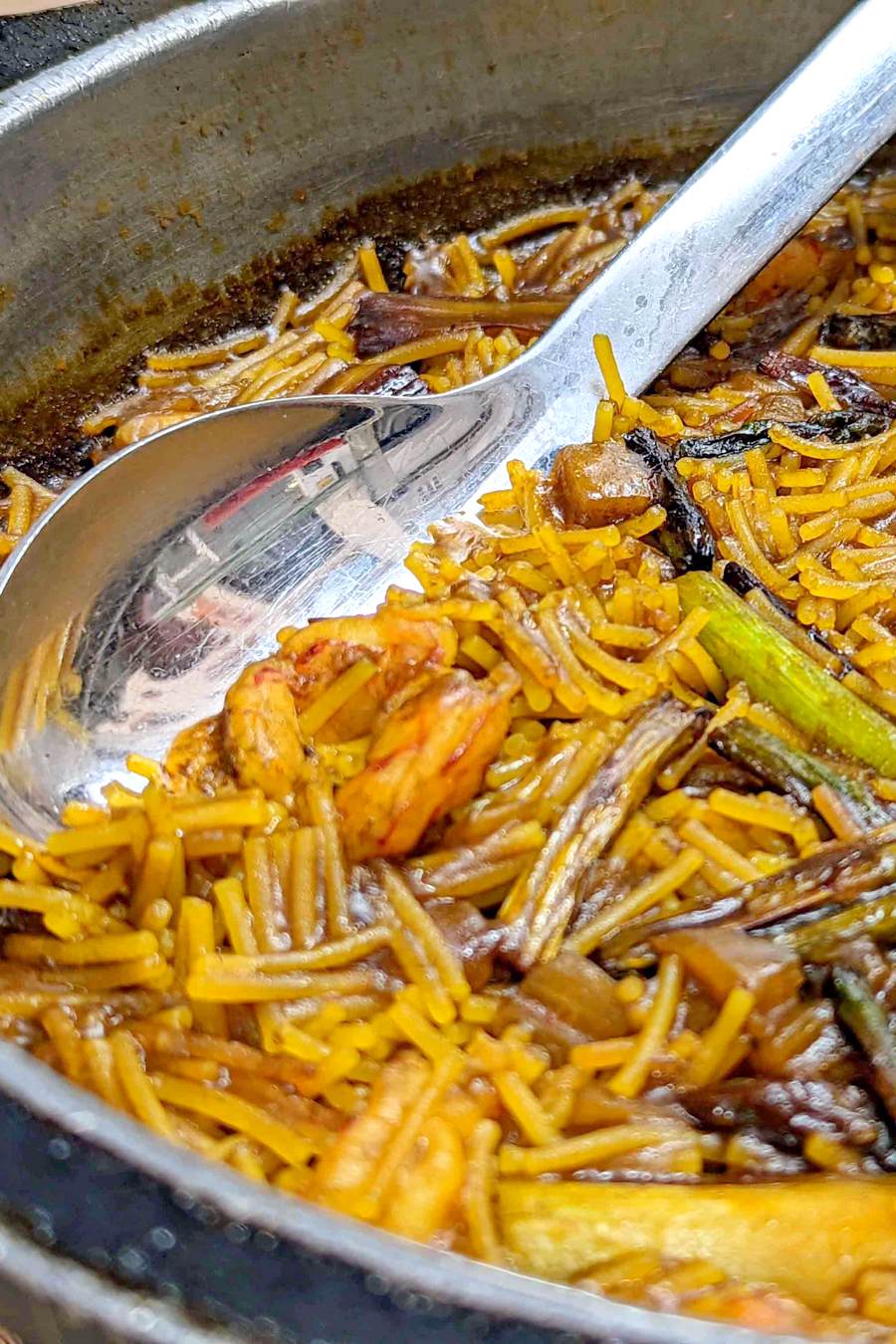
Working with two 20-inch pans on tripods over wood fires, he made both a traditional paella valenciana (similar to ours—see here) and another version featuring squid and its ink with an abundance of vegetables.

We were reminded that the traditional outdoor cooking infuses the paella with a haunting smokiness and helps to guarantee a nice crust along the bottom. We also learned some tips that we expect to use in our own paella endeavors from now on.

For the paella valenciana, Galvez begins by setting the pan over the fire and adding enough olive oil to thinly coat the bottom—and a few tablespoons of coarse sea salt, which we have never done. At this point he fully browns the meat (bone-in pieces of chicken, duck, and rabbit) along with the onion. As the meat browns, he adds paprika and colorante (a coloring agent with some saffron), and stirs well to coat everything. He then adds three kinds of beans—flat green beans cut in 1-inch lengths, meaty white beans found only in the Valencia area, and a flat bean similar to a lima bean.

The handles on most paella pans are attached with rivets. We had never realized that these marks serve as measuring devices. Galvez adds enough broth to bring the mixture up to the bottom of the rivets. Then he adds the rice to bring the mixture to the top of the rivets. He likes to lay out the rice in a cross pattern on top of the soup, then swirl it into the liquid. He says this distributes the rice evenly. Then he adds a large sprig of rosemary—something we had never seen before but is apparently quite traditional. (He fishes it out before the paella is done to keep the herb from making the dish too bitter.)

After all that intensive prep, Galvez simply brings the mixture to a simmer, adjusting the wood beneath the pan to heat it evenly. We were surprised to see that he keeps the burning wood and its coals around the rim of the pan, but not in the middle. This prevents the dish from burning, as the shape of the pan allows the liquid to bubble up on the sides and spread back toward the middle. He never stirs the rice for the 20 minutes it takes to cook.

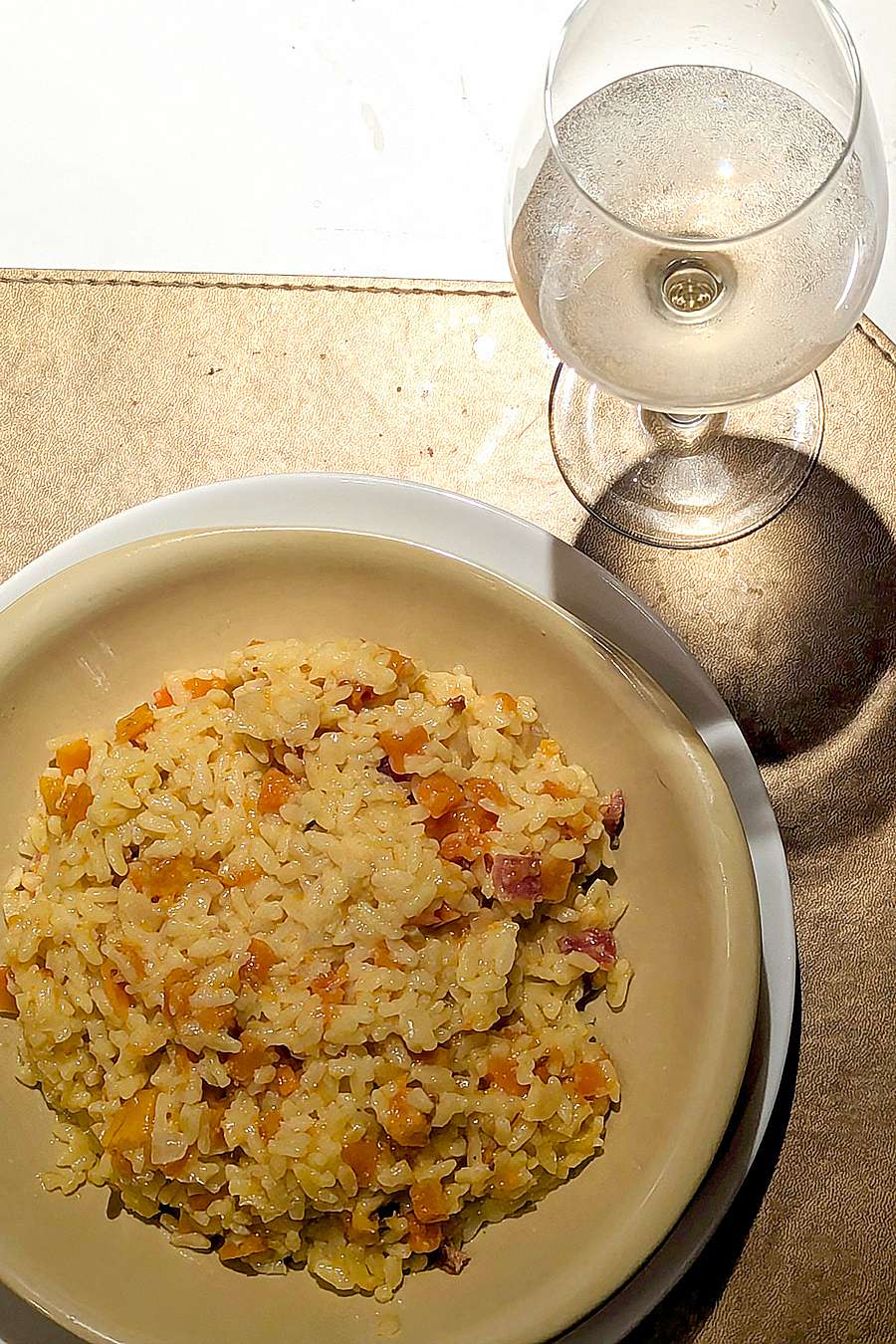
The finished paella is a lovely golden dish, which the restaurant serves with a fruity red wine from the nearby Utiel-Requena district, where the Iberians were making wine from the Bobal grape variety 500 years before the Romans invaded. The rice and the wine are a perfect match.
As soon as the weather permits, we’ll fire up the Weber kettle grill to make paella outdoors. Now if we can just find a red from Utiel-Requena….
La Matandeta is located on the Alfafar-El Saler road, km. 4, in Alfafar. Tel: (011-34) 962-112-184, www.lamatandeta.com. A cooking lesson with meal is 50 euros per person for groups of 10 or more.
And now for some images from Las Fallas:


We don’t feel too bad messing around a little with tradition to make this dish with New England provender. This rich stew hails from the Ebro River valley in La Rioja, but until Napoleon brought potatoes to northern Spain in the early 19th century, this dish was made with chestnuts!
Full disclosure first: We did NOT walk one of the pilgrimage routes to Santiago de Compostela, Spain. But last spring, when we were in northern Spain to research a guidebook, we did see pilgrims everywhere.
del Norte and the Camino Aragónese) converge in Navarra and La Rioja, continuing west across the rugged northern mountains to Galicia. The pilgrimage routes are marked with a scallop shell, and in some places the path parallels the modern paved highway. Many towns along the route were founded as way stations for the pilgrims, like the colorful Santo Domingo de la Calzada, and they usually have hostels where pilgrims can spend the night. Generally, though, the pilgrims are required to hit the road by 8 a.m., rain or shine.
Of course, the football in question is what we Americans call soccer, but the Spaniards are every bit as obsessive about it. As in the U.S., tickets to the games are expensive, and the matches are typically broadcast on premium cable. If you want to see a match in Spain, you go to a bar. 


Reservations are not essential, but might help avoid a wait on the weekend. La Pepica, Paseo Neptuno, 2-8. Tel: 963-710-366,
We love visiting fresh markets when we travel, but except for dried herbs and spices, most of the goods won’t make it through US Customs. Once we’ve snapped dozens of photos of mounds of vegetables and tables of glistening fish on ice, we head to a neighborhood grocery store (the kind where homemakers, not tourists, shop) to stock up on food essentials to bring home.
Canned fish.
Valor chocolate.
We saw many more cows than sheep or even goats as we drove the twisting mountain roads through the Picos de Europa mountain range last spring. Although the Principality of Asturias is the oldest of Iberia’s former kingdoms, the steep green mountains looked more like Switzerland than Spain.