Archive for the ‘Grocery stores’Category

What to buy in a Paris grocery store

It is funny that France is such a fantastic country for eating but we rarely discover as many finds in French grocery stores as we do in other countries. Part of the problem is that most of the good stuff (like the sausages and the fresh produce and seafood) can’t be brought home. The other factor is that many French foods are available in our local groceries, so we have learned to be restrained. We have also found that the fancy stores like Bon Marché and Galeries de Lafayette are big on stocking what they consider exotic delicacies-like American ketchup. There are a few things we just cannot pass up. Here’s our shopping list when we visit Paris:

Herbes de Provence. We’ve been told that this blend of dried herbs typical of the Provençal countryside was invented as a marketing ploy in the 1970s. We don’t care. The blend is handy to toss into almost everything from a stew to a vinaigrette. Why bother to bring it all the way home from Paris? Because, unlike American manufacturers, the French don’t muddy up the flavors by putting lavender flowers and leaves in the mix of savory, fennel, basil, and thyme. And the herbs are cheap if you skip the fancy crockware packaging.

Cassis mustard. Talking with French mustard makers, we learned that even in Dijon, much of the mustard seed comes from Canada, even though it is processed in France. And we are fortunate that some good French mustards (usually Maille) are fairly available in our local stores. But we never see cassis mustard in the U.S., so we always try to pick some up. Its sweet-savory flavor makes it the perfect spread for a sandwich made with leftover charcoal-grilled chicken.


Dried morel mushrooms. Again, they’re available in the U.S., but here in New England they tend to cost an arm and a leg. In France they are relatively cheap, and 3 ounces of dried mushrooms yield about the same volume as a pound of fresh morels. The flavor is intense and meaty. We think the simplest treatment-a morel mushroom omelette-is the best. Rehydrate them by soaking about 5 minutes in warm water and sauté lightly in butter before adding them to the eggs.

Tinned foie gras. Tout le monde makes preserved foie gras, but only the French seem to do it really well. Or, more specifically, the Alsatians. We like the goose foie gras from Strasbourg, which is poached and packed in tins. Once in a while we’ll use some in a sauce, but it’s really best lightly chilled and cut in thin slices spread on a plate and served with a sweet wine. The French prefer Sauternes, but it’s also nice with an intense gewürztraminer from any of the Rhine regions (preferably an auslese).

Crème de marrons de l’Ardeche. This sweetened chestnut cream is France’s answer to Nutella. It’s used in cookies and making millefeuille pastries, as an additive to whipped cream, or just spread on a buttery croissant. The French also like to squirt some from the tube on a crepe and roll it up to serve. It makes a pretty impressive dessert with very little effort. This is one French fast food we heartily endorse.

Drinking chocolate. Every culture does hot chocolate (chocolate chaud) a little differently. In Paris you usually get a little pitcher of hot milk and a little pitcher of concentrated chocolate to mix to taste in your cup. The next best thing to ducking into Angelina (226 rue de Rivoli, (0)1 42 60 82 00) on a chilly Paris day is mixing up a pot of thick hot chocolate at home. The fancier grocery stores in Paris tend to stock Angelina’s mix along with several others. We often pick up extras for the folks who have been feeding the cat or picking up the mail.

Share This Post

08

06 2010

Rum cake finds a new incarnation

Hot Miami chef Dean James Max (who happens to be up for a James Beard restaurateur award this year) is also the talent behind one of our favorite Grand Cayman restaurants, The Brasserie. Part of what makes The Brasserie so terrific is that Max and his staff use local fish, local produce, and all kinds of goodies they grow in the restaurant garden. The menu is also inspired by Caribbean traditions. Of the restaurant’s complex chicken pepper-pot soup, he says, “The peppers you get here on Grand Cayman are just incredible.”

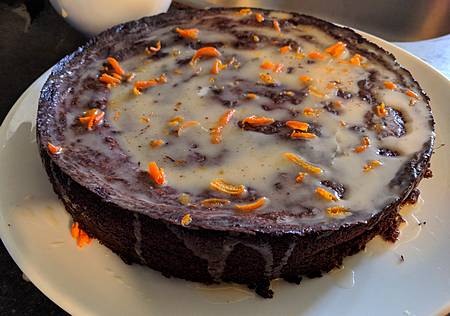
So leave it to Max to find a fun use for the ubiquitous island confection, Tortuga rum cake. (You might recall that we wrote about the cake in What to buy in a grocery store on Grand Cayman Island.)

Alas, we consumed the last of our rum cake stash in late January, so we’ll have to wait for a return visit to make this bread pudding, which we have slightly adapted from his recipe in the April issue of his newsletter. Max comments, “This has been such a cold winter, even for us in Florida, that we really need to coax in the warm summer with a great island style rum cake. I hope you enjoy this simple and tasty recipe! Bring on the heat.”

Tortuga Rum Bread Pudding

Serves 6

Ingredients

8 oz. Tortuga Rum Cake (diced)
2 cups cream
2 Tablespoons sugar
1 vanilla bean
4 eggs
1 cup dried sour cherries
1/4 cup Tortuga rum
3 Tablespoons soft butter

Directions

1. Toast the diced cake pieces on a baking sheet in the oven until they dry slightly and become crisp. Let cool.

2. Mix cream, sugar, and vanilla bean in a saucepan and heat until hot. Remove from heat.

3. In a small bowl, beat the eggs. Stir a small amount of hot cream into the eggs to temper them, then blend eggs slowly into the cream.

4. In a separate small saucepan, heat the rum and cherries and let them soak until cooled. Add cherry-rum mix to the egg-cream mixture.

5. Generously butter a baking pan and scatter the cake pieces to completely cover. Pour the custard over the bread and let it soak at room temperature for 10 minutes.

6. Set the baking dish in a water bath in a preheated 325 degree oven. Cover top loosely with foil and bake for about 30 minutes or until the custard has set. Remove dish from oven; remove foil and let cool. Cut the pudding and serve warm or chilled.

Share This Post

15

04 2010

What to buy in a grocery store on Grand Cayman Island

The explosive growth of top-flight restaurants on tiny Grand Cayman has jump-started local agriculture on this haven for snowbirds and international finance located west of Jamaica and south of Cuba. At the Brasserie, for example, much of the produce on the menu comes from the restaurant’s own gardens and much of the rest from tiny farm patches on the east side of the island.

We would love to bring home some of the local fruits and particularly the Cayman seasoning peppers, which have all the flavor of a Scotch Bonnet and only a fraction of the heat. But US Customs would frown. There are, however, a few preserved foods worth tucking into your suitcase. The Foster’s IGA grocery stores carry Caymanian products that are impossible to find off-island. They also cost far less at Foster’s than in souvenir shops or the hotels. The grocers also carry a nice selection of Jamaican and certain British goods.

Here’s our Grand Cayman shopping list:

Hot pepper jelly.
A tiny amount of Scotch Bonnet pepper supplies the heat to this jelly from Pepper Patch on Grand Cayman, but Caymanian seasoning peppers are responsible for the depth of the flavor. Some 16 ingredients in all go into the tangy jelly, including traces of sweet spices like allspice (called pimento in the Cayman Islands), nutmeg, and cloves. Local residents spread it on water crackers, but we find that a dab of the jelly is the perfect accompaniment to Manchego cheese from Spain.

Cayman sea salt.
Sea salt in most countries is an inexpensive commodity often produced by evaporation in heated pans. This delicate salt is made strictly through solar evaporation and is hand-harvested. It is too expensive to use in marinades, but makes a good finishing salt. The flakes provide delicious salinity and textural crunch. We sprinkle them judiciously on grilled fish and on salads with mangos and baby greens.

Tortuga Rum Cake.
Except for turtle-shaped key chains, rum cake is the #1 Cayman tourist souvenir. They are sweet, dense crumb cakes with a light rum flavor enhanced by the addition of key lime, coconut, or chocolate chips. We are not huge fans and consider them pricey (even at Foster’s). But some of our friends love Tortuga rum cakes, so we bring them home when we have space in the luggage.

Hot sauces.
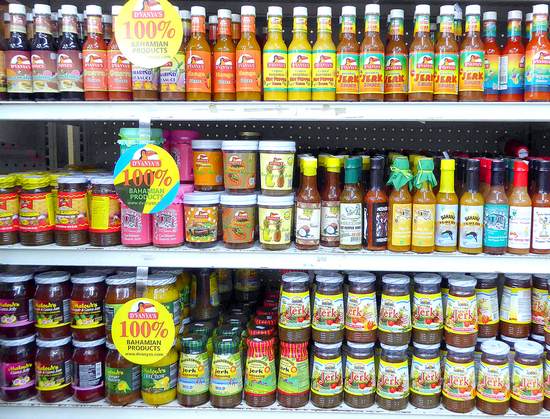
Our appreciation of hot sauces is restrained, since every yahoo with a kettle seems to have started a hot sauce company. Even so, it’s worth cruising the aisles at Foster’s for either of the local companies. Hawley Haven Farm makes down-home farm products, including a hot pepper sauce, while Cayman Islands Sauce Company emphasizes firepower with the likes of Hotter N’ Hell Sauce. Both products are worth a try, though we are just as likely to resort to the Pickapeppa Hot Sauces from Jamaica, readily available at Grand Cayman markets. A few drops of the Spicy Mango or the Gingery Mango Pepper are especially good on grilled mahi.

Share This Post

20

01 2010

Shopping in Valencia for paella tools and ingredients

Mercado Central, Valencia

After tasting paella at La Pepica (see previous post) , we were able to identify the essential ingredients and seasonings we needed to bring home to recreate the dish. The best place to shop for in Valencia for paella fixings is the soaring Modernista train-shed of the Mercado Central (Tel: 963-829-101. www.mercadocentralvalencia.es, open 7:30 a.m.–2:30 p.m. Monday–Saturday). It’s one of the largest fresh markets in Spain, perhaps because the area around Valencia is intensively agricultural. The subtropical climate not only permits year-round cultivation of greens and legumes, the swampy lagoons are also home to some of Spain’s most prized rice plantations. You cannot take home the fresh veggies, but you can bring the heirloom rice, the spices, and the special pans for making paella.


The best paella is made with Bomba rice, an heirloom variety introduced to the area by the Moors in the 8th century and still grown in the Albufera wetlands south of the city. It is nowhere as productive as modern rice, but has an exceptionally nutty flavor and will absorb nearly twice as much liquid as other short-grain rice while still remaining al dente. La Pista Pastor, at stall #43, sells it.


Pimentón a la Vera

The other critical items for a good paella are saffron and Spanish paprika. Pimentón a la Vera is a subject unto itself, but let it suffice that Antonio Catalán (stall #457) drew us into his orbit with heaping mounds of bright red sweet and hot paprika and a brick-colored hill of smoked paprika (pimentón ahumado). He also has the best prices in the market on saffron, and cheerfully educates buyers on the subtle differences between grades. (Bottom line: Try to purchase whole threads with few or no golden flecks.)

Paella pans

Strictly speaking, of course, “paella” is not the rice meal, but the metal pan in which it is cooked. The shallow pans ensure that the rice is spread out well, and the thin metal guarantees a fine crust on the bottom. It is only a slight exaggeration to say that you can’t make a proper paella without a real paella pan. We knew we could purchase one at home (where it would be more expensive) but couldn’t pass up the array of iron and stainless steel pans at Ceramicas Terriols (stall #51), where the proprietor provides a recipe with every purchase.

Share This Post

06

01 2010

What to buy in an Italian grocery store

Since so many of the regional Italian cuisines are based on food that is fresh, fresh, fresh, we’re limited in what we can bring back home. But there are some dry goods and conserves that turn out to be very useful in cooking Italian dishes. We’ve learned not to bother with colored pastas, which cook up to a gray mess anyway, because we can buy good imported dry pasta for about the same price we’d pay for it in Italy.

Here’s our Italian grocery list:

AnchoviesAnchovies.
Many Americans think they don’t like anchovies because they have never tasted good ones used with the restraint characteristic of Italian recipes. We look for anchovies packed in glass jars so we can make sure they are firm and whole. We also check the jar for an expiration date several months in the future.

Dried mushrooms.
Dried fungi, especially dried porcini mushrooms, are central to a number of pastas and risottos. Alas, purchasing in an Italian market doesn’t provide much of a price break over buying in US gourmet import stores, but because Italian cooks use a lot of dried mushrooms, the shelf stock is always fresh. Even dry, porcini should remain flexible.

RicesRice.
We buy arborio for most risottos, but always get some vialone nano for seafood risottos, and Roma for Roman rice dishes. They’re all strains of short-grained, oval rice. The less expensive riso originale (the more generic mother strain) is a good choice for soups or arancini, but we rarely buy it unless we have a lot of room left in the suitcase. The same one-kilo box of vialone nano we buy in Italy for two euros is nearly $15 in the U.S.

Bouillon cubes.
Bouillon cubes and soup bases differ from country to country-even the international brands like Knorr. Those sold in the Italian markets are seasoned to Italian taste, and work very well as a backup for having your own homemade stock. We like the Starr brand, especially the porcini mushroom bouillon cubes.

Mushroom salad.
Jarred marinated mushrooms provide an instant antipasto. We generally look for mixed “woods” mushrooms for variety of colors and shapes. Fior di Bosco is a good choice.

Tomato pasteTomato paste in a tube.
Often ridiculously expensive at home, the tubes of double-concentrated Italian tomato paste are a perfect solution for providing just a touch of tomato to a soup or a sauce. The flavor is typically richer and a little sweeter than canned tomato paste.

Herbs.
There are few dried herbs used in Italian cooking that we can’t buy at home, but we like the aromatic sweetness of Italian oregano for seasoning sauces and salads.

Salt.
Like the Spaniards, the Italians typically use sea salt to season their food, though their salt is usually more refined than the Spanish. Italian processed sea salt is usually found in both fino and grosso (fine and coarse). The coarse salt is intended for oven-roasting fish or meat, but can do double duty in a salt grinder.

MostardaMostarda de la Cremona.
The great cookbook author (and all-around generous soul) Michele Scicolone turned us on to this conserve of small fruits poached in sugar syrup until they become nearly translucent. A secondary seasoning with mustard syrup gives the mostarda a sweet-savory quality similar to a chutney, but even more beautiful to serve with a bollito misto (a ring of mixed meats). You can buy it in bulk at deli counters as pictured, but mostardas are also sold in jars (easier to take home).

Share This Post

18

12 2009

What to buy in a Spanish grocery store

SpanishpimentonWe love visiting fresh markets when we travel, but except for dried herbs and spices, most of the goods won’t make it through US Customs. Once we’ve snapped dozens of photos of mounds of vegetables and tables of glistening fish on ice, we head to a neighborhood grocery store (the kind where homemakers, not tourists, shop) to stock up on food essentials to bring home.

Here’s our Spanish grocery list:

Saffron.
Spaniards claim their saffron is the world’s best and price it accordingly. The larger the container, the better the deal. We usually purchase saffron in 20-gram boxes or larger. (A half gram is sufficient for a 15-inch paella.) Stored in an airtight container out of the light, it will keep up to seven years—or so we have been told. It never lasts that long for us.

Pimentón de la Vera.
The colorful tins holding this smoked paprika from Extremadura are almost irresistible. The earthy red spice with a mild hint of smoke is used to season chorizo and most forms of paella. It’s most commonly available as dulce (sweet) or picante (hot). The dulce, which is slightly hot, is the best to add a touch of warmth and deep coloring to rice dishes and soups and is the main paprika used in Spanish sauces (including Bravas sauce). The picante is at least as hot as most Mexican chile peppers, and should be used sparingly. If we plan to make a barbecue dry rub, we look for the less common ahumado, which has a strong smoky component.

Sea Salt.
Flaked sea salt is a current foodie favorite, but we prefer the coarser Spanish sea salt sold for roasting fish or fowl. It can be ground in a salt grinder to use at the table or tossed into liquids as a seasoning. Our favorite brand, Sal Costa from the Costa Brava, costs less than a half euro per kilo.

fishtinsCanned fish.
The Spaniards are canning geniuses, and their tinned anchovies, oysters, squid, octopus, clams, and sardines are the secret behind half the tapas served in the bars. The white anchovies in particular are so good that the Italians import them.

Olive oil.
Olive oil is a matter of personal taste, but Spaniards tend to concur that the best in Spain comes from Andalucía—either from Núñez del Prado, or from hill towns around Úbeda. Best bet is “bionatur” oil packaged in tins rather than bottles.

Bomba rice.
This heritage strain of rice introduced to the Valencia area from North Africa around 800AD is the premium rice for paella. It’s twice as expensive as “Valencia” rice, and worth every cent for its ability to absorb flavor and maintain its toothy texture.

Manchego cheese.
This aged ewe’s milk cheese is the pride of Spanish cheeses. We sometimes bring an entire three-kilo wheel home, but big vacuum-sealed wedges are also available in most grocery stores. It keeps fine for several days without refrigeration.

PouringhotchocolateValor chocolate.
Anyone who visits in cool weather soon discovers the soothing pleasures of Spain’s unusually thick hot chocolate. Valor is a common supermarket brand for recreating the treat at home. It’s even good without the accompanying churros.

Share This Post

09

12 2009